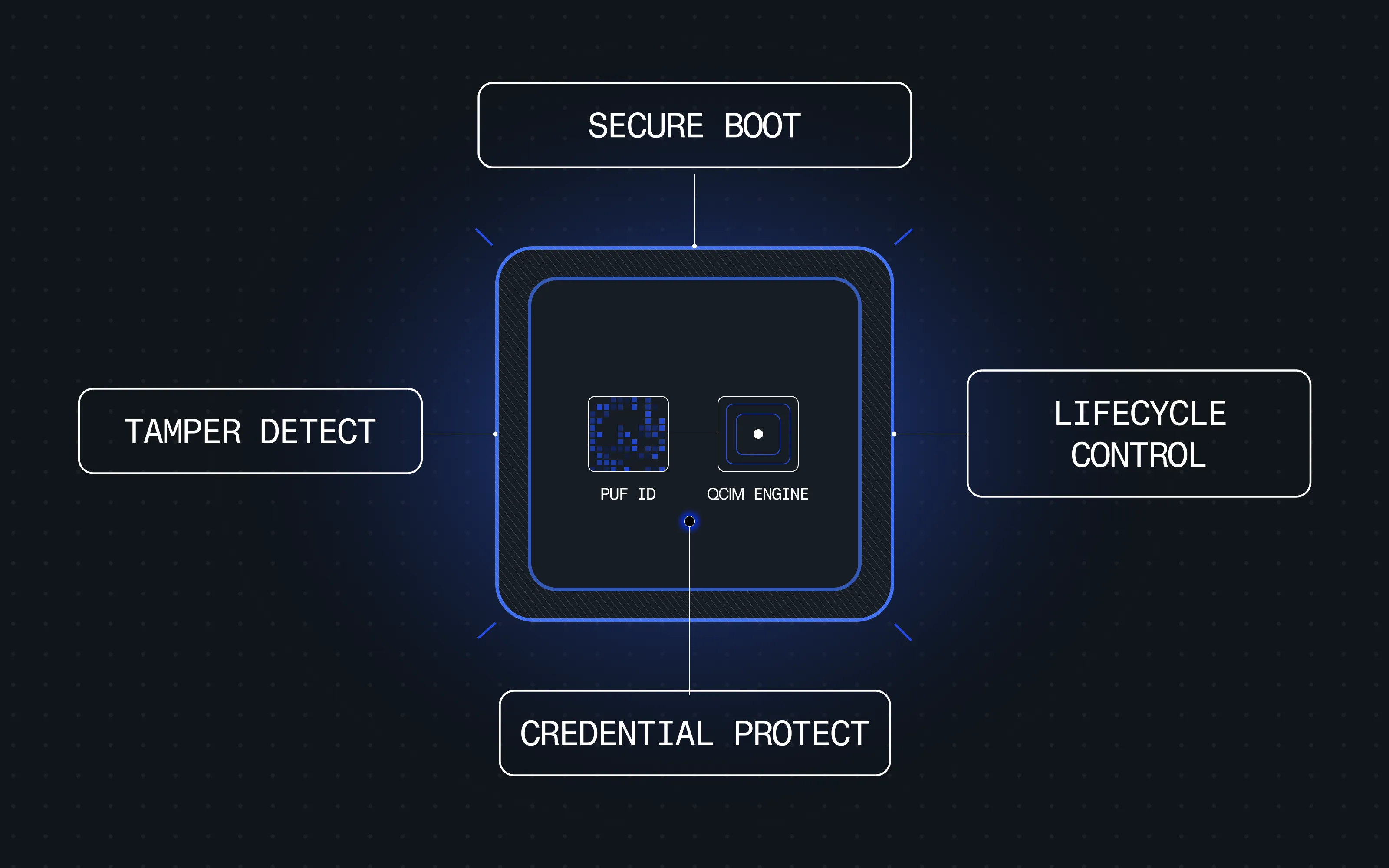
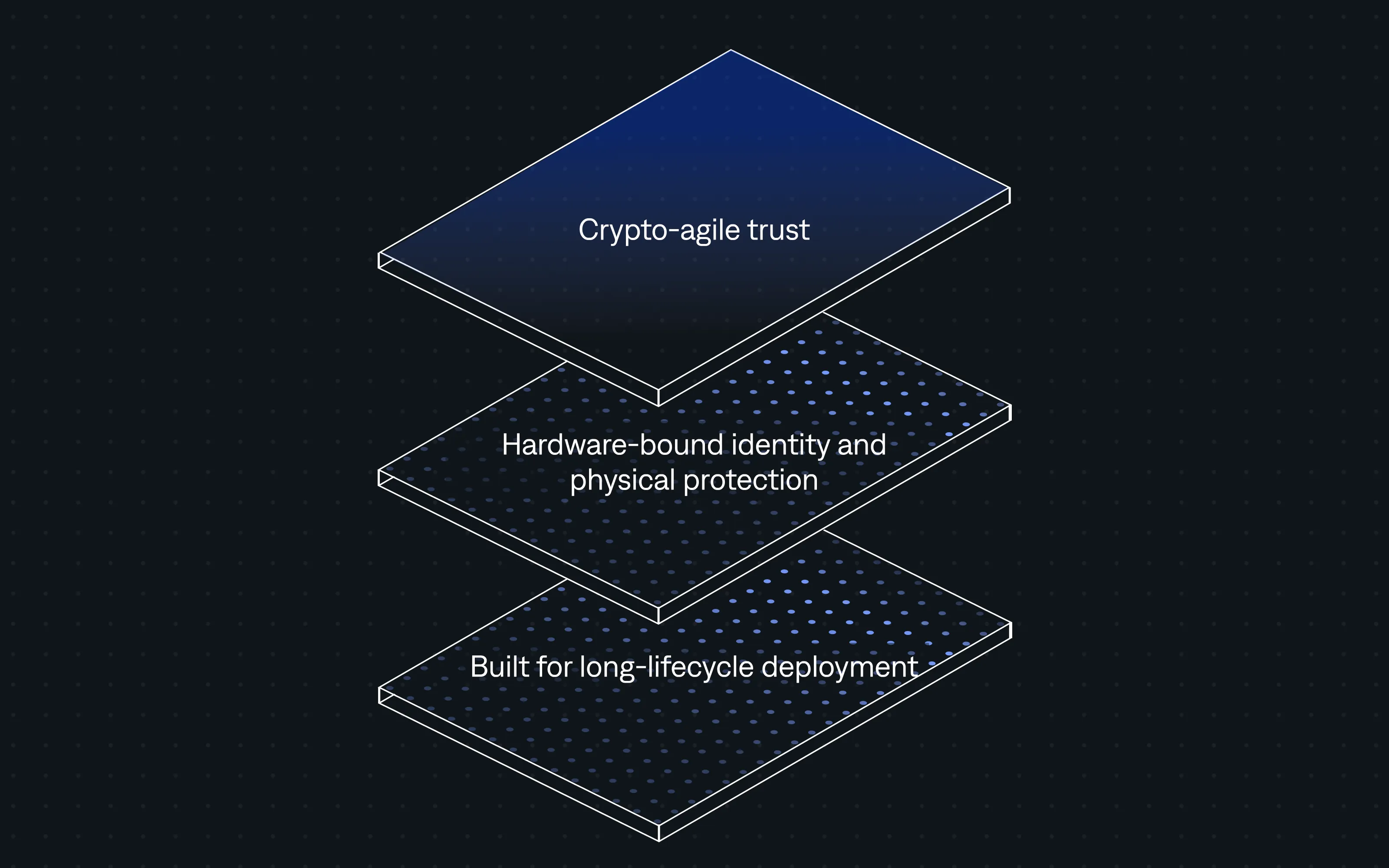
QCIM Root of Trust combines hardware-bound identity and secure-element protection with the reprogrammable QCIM Engine, creating a hardware trust anchor whose cryptographic capabilities can evolve after deployment.

The Engine executes the cryptography, the Root of Trust establishes device trust, and the Platform maintains that trust after deployment.
Designed for high-security applications, QCIM RoT delivers the benefit of crypto agility in a small, secure root-of-trust usable as semiconductor IP, and soon as a standalone chip. Fully featured with anti-tamper systems, secure boot, and supply-chain security to bring trust to any chip.

Supports classical cryptography and PQC standards from NIST. Capable of supporting diverse PQC roadmaps from the EU, Korea, and other countries through secure update mechanisms.
Combines state-of-the-art VIA PUF™ from ICTK, tamper detection, and side-channel masking to provide strong resistance to physical attacks. These mechanisms form an unassailable identity against quantum computing, AI, and supply-chain attacks.
Achieves industry-standard security and performance expectations at extremely small power and area footprints. Designed for a diverse range of end-use requirements in defense, automotive, IoT, and mission-critical sectors.
PUF-derived device identity, root key and credential protection.
Secure boot, firmware verification and protected execution.
Tamper detection, side-channel protection, fault detection and zeroization.
Controlled debug, authorized updates, crypto-kernel updates and security-state management.
A physically unclonable function supplies the device identity and root key, with no stored secret to extract.
Versioned cryptographic kernels let the root support classical and post-quantum algorithms, and change them after deployment.
Secure boot, memory protection, tamper and fault response, controlled debug, and authorized security-state changes.
Request technical specifications, evaluation IP, or a consultation with our hardware security team.